






I. School Profile
Communication University of China (CUC) is a top-tier university directly under the Ministry of Education. It is among the first group of universities included in the "Double First-Class" initiative, a key university under "Project 211," and a member of the "985 Innovation Platform for Advantageous Disciplines." Founded in 1954, it was the first media-focused institution of higher education established by the Communist Party of China after the founding of the People’s Republic of China. In August 2004, it was renamed Communication University of China from its former name, the Beijing Broadcasting Institute. Over its 70-year history, adhering to the motto of "Integrity, Professionalism, Erudition, and Competence," the university has cultivated a vast number of outstanding media professionals who meet the needs of the Party and the state, possess the capacity to enhance capacities in the face of future media challenges, and excel on the international stage. It is widely acclaimed as the "cradle of China's radio, film, and television talent," a "renowned institution in the field of information communication," and a "major educational stronghold for the Party's ideological work and cultural progress."
The university currently boasts two national "Double First-Class" disciplines: Journalism and Communication, and Drama, Film and Television. It also features two Beijing municipal high-precision and sophisticated disciplines—Internet Information and Cultural Industries—alongside three primary Beijing municipal key disciplines: Journalism and Communication, Theory of Art, and Drama, Film and Television. Furthermore, it has four secondary Beijing municipal key disciplines: Linguistics and Applied Linguistics, Communication and Information Systems, Electromagnetic Field and Microwave Technology, and Animation. The institution hosts seven postdoctoral research stations, six primary discipline doctoral degree authorization points, 16 primary discipline master's degree authorization points, four doctoral professional degree authorization categories, and 14 master's professional degree authorization categories. Throughout the development process, each discipline has strived to create unique, world-class characteristics and has achieved crucial breakthroughs. Multiple disciplines, including Journalism and Communication and Drama, Film and Television, have attained remarkable achievements; Design and Theory of Art both rank in the top tier, while several professional degree programs lead the nation in performance.
The university possesses abundant research resources and formidable strengths, featuring 5 national-level platforms and 29 provincial, ministerial, and other high-level research platforms. Addressing major national strategic needs—such as media convergence, international outreach, public opinion and social governance, area and country studies, fostering a sense of the Chinese nation as one community, building a community with a shared future for mankind, and the construction of China's independent knowledge system—the university has established a "Three National" major research platform system. This system, centered on the State Key Laboratory of Media Convergence and Communication, the National Public Opinion Laboratory, and the Ministry of Education's Joint Research Institute of International Communication, continuously enhances the university's capacity and level of service to national development agenda. The university publishes three CSSCI journals—Modern Communication, Modern Publishing, and Journal of News and Communication—as well as the ESCI-indexed English academic journal Global Media and China, and other academic publications such as Art and Communication Research and Information and Communication Research. Furthermore, it co-hosts CSSCI-source journals like Contemporary Cinema and China Television, providing robust platform support for the university's "Double First-Class" initiative and scientific research progress.
The university attaches great importance to teachers’ qualifications and is deeply implementing the strategy of strengthening the school through human resources. Through a series of reform measures, the university continues to deepen the institutional reform of personnel and talent management. It has streamlined the growth chain for talent—from postdoctoral researchers to 'Young Excellence' and 'Golden Walnut' talents—and established a "Golden Decade" cultivation system designed to nurture master teachers. The university has introduced a "Ten-Character Policy" for talent evaluation based on "representative works, contribution, and subjective evaluation," and implemented "individualized cultivation plans" for young teachers. These efforts have created a fertile ground for talent growth with unique CUC characteristics and a sound atmosphere for development, fostering a spirit of hard work and proactive entrepreneurship among the faculty and staff. Moving forward, the university will ensure the full implementation of the fundamental task of fostering virtue through education. Closely aligning with major national strategic needs and the goal of building a leading country in education, the university will focus on the "Three Leaps" strategic task as it continuously advances the development of a world-class media university with Chinese characteristics.
II. Project Positioning
Since 2021, the National Natural Science Foundation of China (NSFC) has established the Excellent Young Scientists Fund (Overseas). This program aims to attract and encourage outstanding young scholars from overseas (including non-ethnic Chinese foreigners) who have achieved significant accomplishments in natural sciences, engineering, and technology to return to or come to China. It empowers them to independently choose their research directions to conduct innovative research, promotes the rapid growth of young science and technology talent, and cultivates a cohort of excellent academic mainstays with the potential to reach the global frontiers of science and technology, thereby contributing to the goal of building a country that is strong in science and technology.
In alignment with our university's strategic development and the requirements for building a high-caliber talent pool, we cordially invite outstanding young overseas scholars in the fields of Information and Communication Engineering, Electronic Science and Technology, Computer Science and Technology, Cyberspace Security, Economics and Management, and related interdisciplinary sectors to apply for the 2026 National Science Fund for Excellent Young Scholars (Overseas) through our institution.
III. Application Requirements
(1) Applicants for the Excellent Young Scientists Fund (Overseas) must meet the following criteria:
1. Abide by the laws and regulations of the People's Republic of China, uphold high standards of scientific ethics, and conscientiously practice the spirit of scientists in the new era;
2. Date of birth must be on or after January 1, 1986;
3. Must hold a doctoral degree;
4. Research directions primarily focus on the natural sciences, engineering, and technology, among others;
5. After obtaining a doctoral degree and prior to April 15, 2026, applicants should generally have held formal teaching or research positions at prestigious overseas universities, scientific research institutions, or enterprise R&D centers, with at least 36 months of continuous work experience. For those who obtained their doctoral degrees overseas and have demonstrated particularly outstanding achievements, the requirement for years of work experience may be appropriately relaxed (this relaxation does not apply to individuals who obtained their overseas doctoral degrees through Chinese-foreign joint training programs).
For applicants who hold a paid position within China while working abroad, the years of service in the domestic paid position shall not be counted toward their years of overseas work experience.
6. Have achieved research or technological results recognized by peer experts, and demonstrate the potential to become an academic leader or an outstanding talent in the field.
7. Applicants must not yet have returned to China for full-time employment, or must have returned to China for work after January 1, 2025. Upon notification of funding, the applicant must resign from their overseas position and work full-time in China for no less than three years.
(II) Requirements on the limit of applications
We must implement the relevant requirements for the coordination and integration of national science and technology talent programs. An individual may only undertake one program at the same level and is prohibited from applying for programs at a lower level than those they have already completed.
For specific requirements, please refer to the official 2026 Project Guidelines for the Excellent Young Scientists Fund (Overseas) of the National Natural Science Foundation of China.
IV. Supporting Measures
(I) State Support:
1. Funding Intensity: 1 to 3 million yuan.
2. Funding Period: 3 years.
(II) School Policies:
Those who are successfully selected for the National Natural Science Foundation of China (NSFC) Excellent Young Scientists Fund (Overseas) with the Communication University of China (CUC) as the host institution will receive subsidies and support from the state. In addition, the university will provide a favorable working and living environment, which primarily includes:
1. Providing competitive compensation and position benefits:
(1) Providing staffing within the official administrative quota for school personnel;
(2) Offer competitive compensation and performance-based incentives.
2. Providing an excellent development platform:
(1) Direct appointment to the position of young professor;
(2) Appointed as a doctoral supervisor to rapidly build a team;
(3) The school invites experts to provide guidance on formulating "one person, one policy" growth plans, providing comprehensive support throughout the process.
3. Providing strong momentum for scientific research:
(1) Provide research start-up funding based on the research direction and actual needs;
(2) Support the formation of scientific research teams, provide the use of official office space, and offer a robust development platform and comprehensive guarantees.
4. Providing thoughtful living guarantees:
(1) Provide transitional housing to address housing difficulties;
(2) Assist in handling children’s education to eliminate any lingering concerns.
Applicants who apply for the Overseas Excellent Young Scholars program through the university and reach the final evaluation stage but are not ultimately selected may be prioritized for recruitment as top-tier young talents of the Communication University of China (CUC) in accordance with established procedures.
V. Contact Information
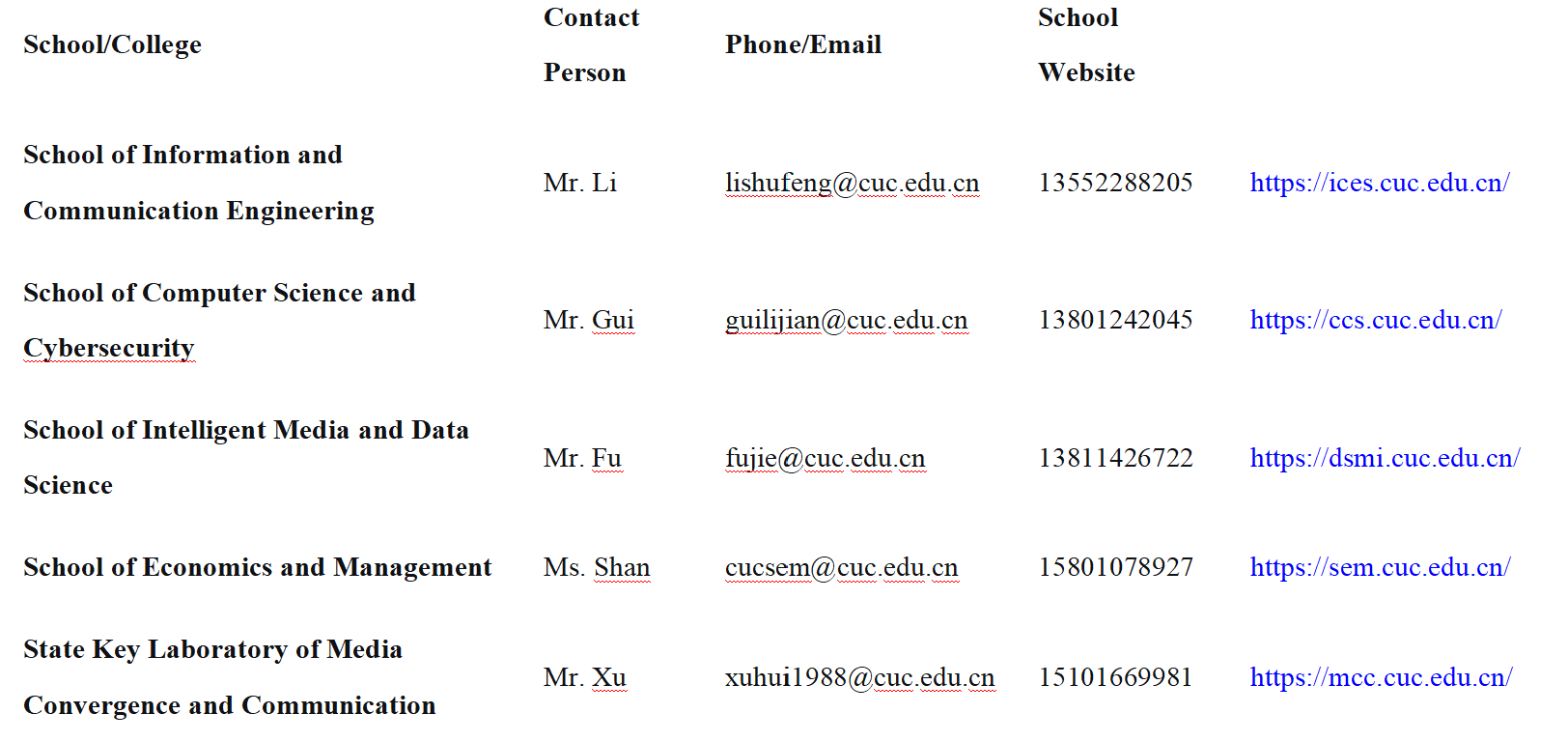
Interested applicants may contact the relevant schools and send their CVs to the designated contact person, with a carbon copy to the Communication University of China (CUC) Human Resources Department at rcb@cuc.edu.cn. Please indicate "2026 Overseas Excellent Young Scholars Program" in the subject line and provide basic personal information, educational and professional background, major academic achievements, and contact details. For those who meet the application requirements, we will get in touch with you as soon as possible.
For inquiries regarding employment policies and human resources development, please contact the Personnel Office of the Communication University of China (CUC). Contact persons: Mr. Gao and Mr. Li. Contact numbers: 010-65783549, 010-65779225.
Contact information for all relevant teaching and research units:
This article was translated with AI assistance.
Editor: Fang Yiran