



By Zhang Yanqiu, Zhang Zhihua
From August 17 to 24, Vice President Cai Jianping of our university led a delegation to renowned universities in Argentina and Uruguay for academic exchanges and cooperation visits. Professor Zhang Yanqiu of the Institute for a Community with a Shared Future for Humanity and Professor Zhang Zhihua of the School of Journalism accompanied the delegation.
The delegation participated extensively in the Fourth Latin American China Studies Conference. During the conference, it jointly organized a thematic seminar entitled "Towards a Community with a Shared Future for Humanity" with the National University of La Plata in Argentina, and released the English version of the important research achievement Argentina and China:Building a Sino-Latinamerican Community with a Shared Future, jointly completed by our university's Institute for a Community with a Shared Future for Humanity and the Center for Latin American Studies on a Community with a Shared Future for Humanity and the Belt and Road Initiative. The delegation also held inter-university meetings with key universities in Latin America, including the National University of La Plata in Argentina, the Catholic University of Uruguay, and the University of the Republic of Uruguay, and conducted field research at local Confucius Institutes and Chinese-language media.
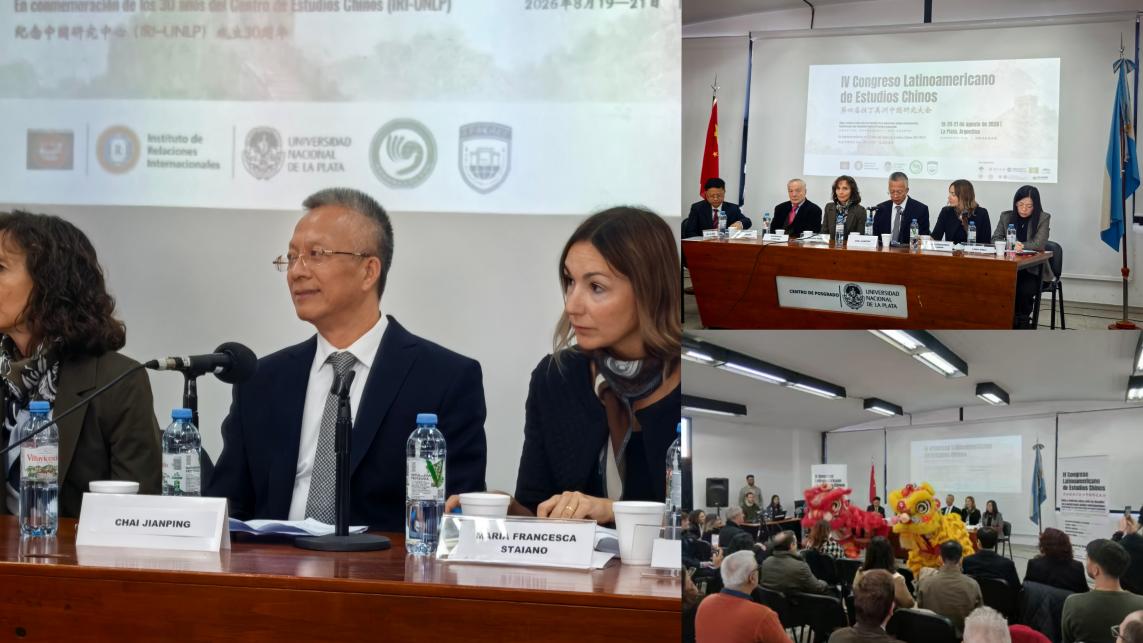
Vice President Cai Jianping delivers a speech at the opening ceremony of the Fourth Latin American China Studies Conference
On the morning of August 19 local time, the Fourth Latin American China Studies Conference grandly opened at the National University of La Plata in Argentina, and Cai Jianping was invited to deliver a speech at the opening ceremony. The theme of the conference was "Building a Community with a Shared Future for Humanity: China and Latin America's Solutions to Contemporary Global Governance Challenges." The Institute for a Community with a Shared Future for Humanity of our university, as a co-organizer of this conference, was deeply involved in organizing the thematic session on a Community with a Shared Future for Humanity. Nearly 250 experts and scholars from 17 countries conducted discussions on such topics as a Community with a Shared Future for Humanity, artificial intelligence, sustainable development, and changes in global governance. The Latin American China Studies Conference is known as "one of the most representative interdisciplinary dialogue and research mechanisms in Latin America." This conference coincided with the 30th anniversary of the establishment of the Center for Chinese Studies at the National University of La Plata. It attracted nearly 250 scholars from 17 countries, including Argentina, Brazil, Mexico, and Chile, making it the largest conference in its history. Dozens of Latin American media outlets, including the Argentine National News Agency, Xinhua News Agency, the Latin America News Agency, El Diario Las Americas, and Southern Television, reported on the event.
Cai Jianping pointed out in his speech at the conference that the world today is undergoing profound adjustments in its global landscape, with multiple global challenges, including imbalanced development, technological iteration, and governance transformation, becoming intertwined and superimposed. This is also the contemporary value and core essence of the concept of building a Community with a Shared Future for Humanity. Cai Jianping emphasized that the continuous innovation of artificial intelligence technology has reshaped global research paradigms, industrial structures, and governance systems. At the same time, however, structural problems objectively exist in the global field of intelligence, including uneven distribution of technological resources, insufficient flows of innovation, and differences in development levels. He particularly pointed out that the World Artificial Intelligence Conference held in Shanghai this July upheld the core principles of AI for good, openness and inclusiveness, and inclusive governance, and advocated that artificial intelligence should become a public technological product serving all humanity. This development philosophy of openness and win-win cooperation is highly consistent with the core values of treating each other equally, pursuing mutual benefit and win-win outcomes, and working together in solidarity advocated by the concept of building a Community with a Shared Future for Humanity. Cai Jianping stated that China and Latin America are both important forces of the Global South, with similar development circumstances, compatible development philosophies, and converging development aspirations. Our university is willing to work together with colleagues in the Latin American academic community to promote the implementation of the four major global initiatives, jointly participate in global AI governance, contribute to the inclusive development of artificial intelligence, and continuously deepen practical exchanges and cooperation between China and Latin America in higher education and academic fields. His speech received broad resonance among the participating Latin American experts and scholars.
After the opening ceremony, the conference immediately proceeded to the thematic seminar "Towards a Community with a Shared Future for Humanity," jointly organized by the Institute for a Community with a Shared Future for Humanity of our university and the Center for Latin American Studies on a Community with a Shared Future for Humanity and the Belt and Road Initiative, which was jointly established by the two universities. Professor Zhang Yanqiu, Deputy Director of the Institute for a Community with a Shared Future for Humanity, and Professor Zhang Zhihua of the School of Journalism delivered keynote speeches. In her speech entitled "A Community with a Shared Future for Humanity: A Global Governance Initiative Perspective," Zhang Yanqiu proposed that, in the process of promoting the building of a China-Latin America Community with a Shared Future, Chinese and Latin American academics should reflect on and move beyond the single logic framework of Western neoliberalism and explore new paths of mediatized governance that are adapted to the local development needs of countries in the Global South. In his speech entitled "South-South Communication: Facing a Balanced World Communication Order," Zhang Zhihua pointed out that countries and regions of the Global South, including China and Latin America, should reactivate the legacy of internationalist solidarity and decolonization from the 20th century and, within the framework of a Community with a Shared Future for Humanity, promote the construction of a new international communication order through South-South communication.
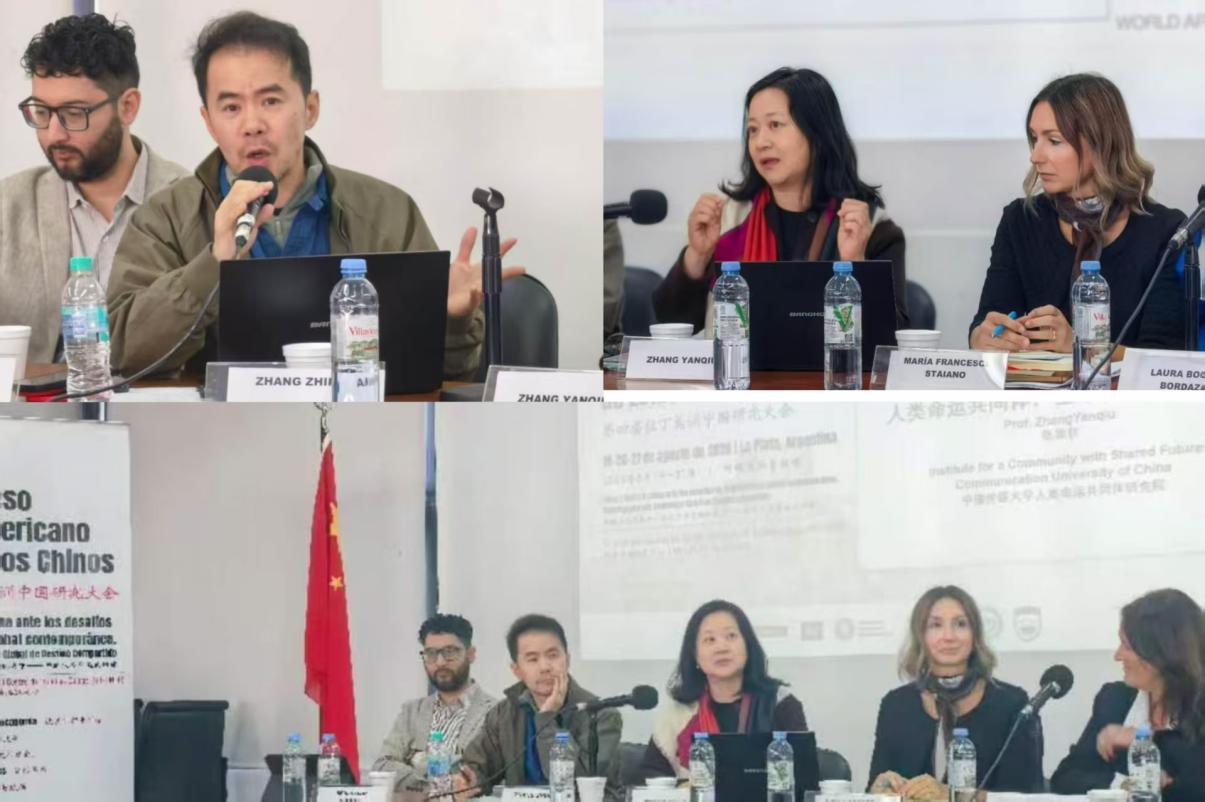
Zhang Yanqiu and Zhang Zhihua speak at the Fourth Latin American China Studies Conference
At the thematic seminar "Towards a Community with a Shared Future for Humanity," the Institute for a Community with a Shared Future for Humanity of our university and the National University of La Plata jointly held a book launch for Argentina and China:Building a Sino-Latinamerican Community with a Shared Future. The book is an important research achievement produced by the Center for Latin American Studies on a Community with a Shared Future for Humanity and the Belt and Road Initiative, jointly established by the two universities. Zhang Yanqiu, Deputy Director of the Institute for a Community with a Shared Future for Humanity, and Sī Fulan, Director of the Center for Latin American Studies on a Community with a Shared Future for Humanity and the Belt and Road Initiative, jointly introduced the publication and editorial positioning of the book and its core research topics.
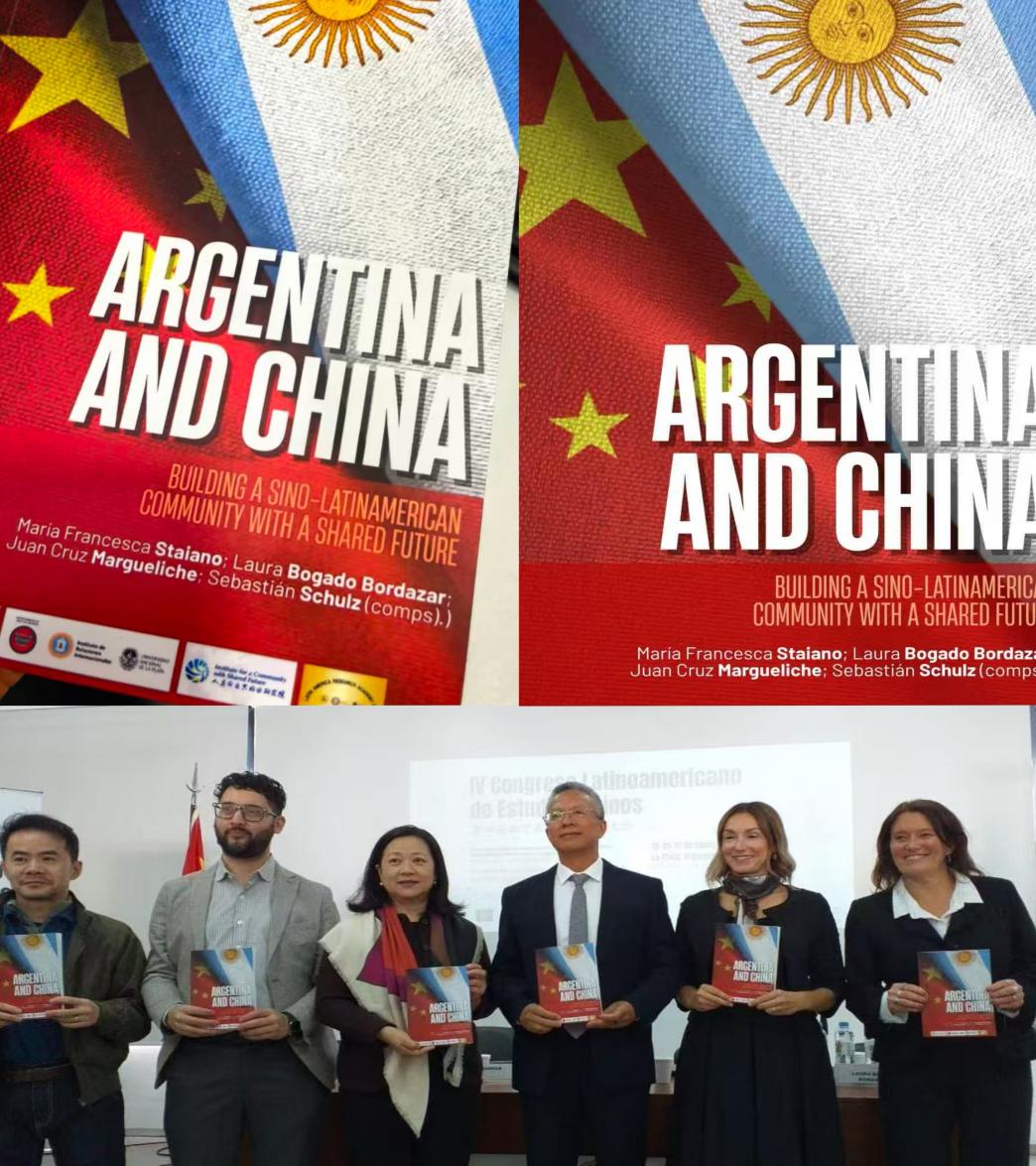
Book launch at the Fourth Latin American China Studies Conference
Conducting High-Level Inter-University Exchanges with Renowned Latin American Universities and Expanding Our University's Cooperation Network in Latin America
On August 18, the delegation participated in a joint working and academic exchange meeting with the Institute of International Relations of the National University of La Plata. Cai Jianping and his delegation held a preparatory meeting with Norberto Consani, Dean of the Institute of International Relations, Sī Fulan, Director of the Center for Chinese Studies and the Center for Latin American Studies on a Community with a Shared Future for Humanity and the Belt and Road Initiative, and others for the thematic seminar "Towards a Community with a Shared Future for Humanity" of the Fourth Latin American China Studies Conference, jointly organized by the two universities the following day. The two sides also conducted focused discussions on deepening the relevant work concerning the Center for Latin American Studies on a Community with a Shared Future for Humanity and the Belt and Road Initiative, jointly established by the two universities. On the basis of summarizing the achievements of the past five years of cooperation, they planned and discussed the priorities and directions for future work. At the same time, the two sides conducted in-depth exchanges on the dissemination of the concept of a Community with a Shared Future for Humanity in Latin America.
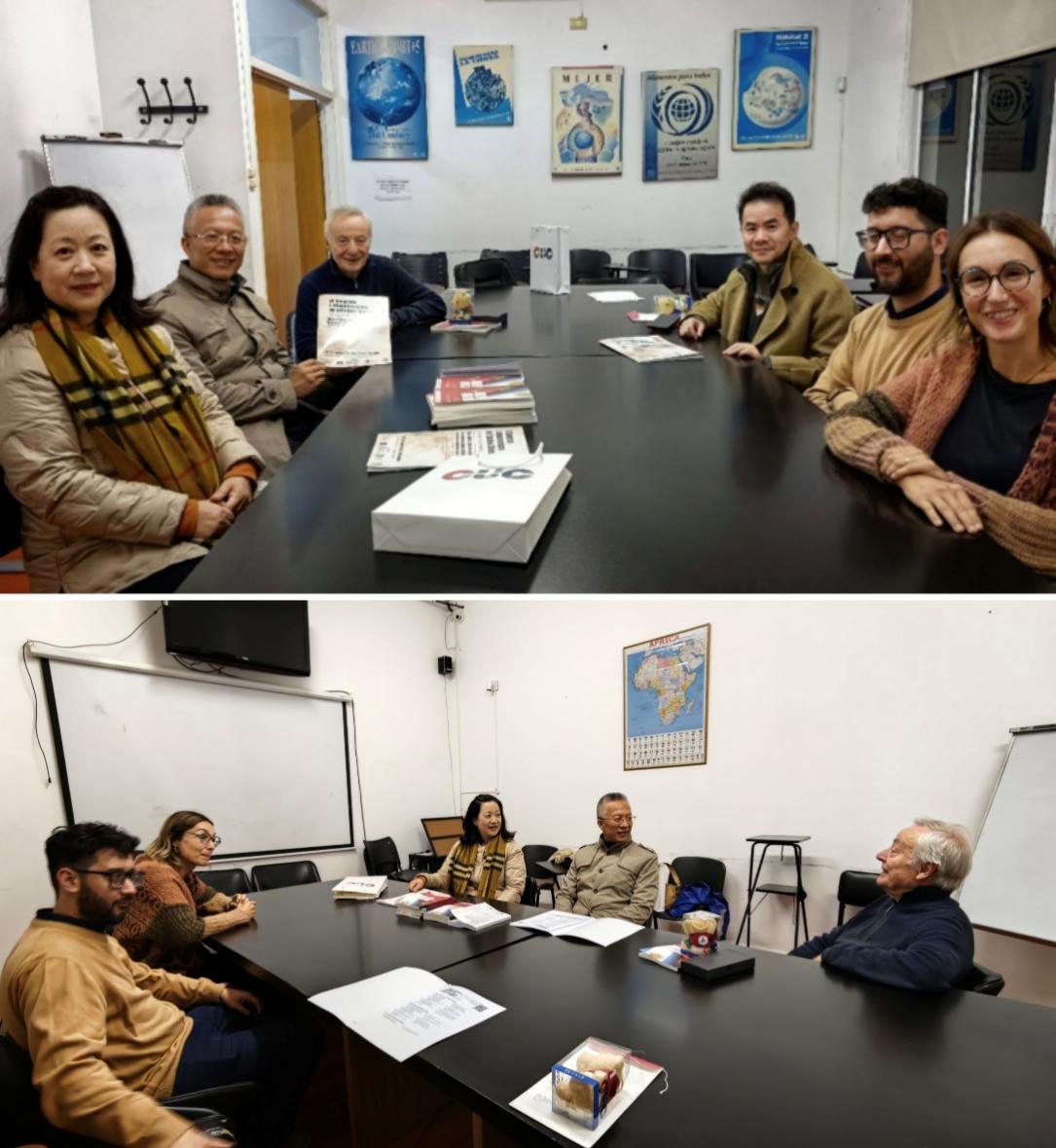
The delegation holds a joint working meeting with the Institute of International Relations of the National University of La Plata
On the afternoon of August 19, Cai Jianping and his delegation held talks with Marcelo Pecoraro, Vice President of the National University of La Plata, as well as the Dean of the university's Institute of International Relations and experts and scholars in the field of artificial intelligence research. The National University of La Plata is one of the oldest public universities in Argentina. In December 2024, Liao Xiangzhong, Secretary of the Party Committee of our university, led a delegation to visit the university, and the Center for Latin American Studies on a Community with a Shared Future for Humanity and the Belt and Road Initiative, jointly established by the two universities, was officially inaugurated. This event represented a concentrated manifestation of the two sides' deep cooperation over the past two years. During the talks, the two sides conducted in-depth exchanges on such topics as joint research and experience exchange in artificial intelligence, the development of the Joint Research Center on a Community with a Shared Future for Humanity, and international communication research between China and Argentina. Cai Jianping focused on sharing our university's practical experience in promoting systematic transformation of education and teaching through AI empowerment, as well as innovation in scientific research and management. Vice President Pecoraro introduced the university's research work in the field of AI and expressed expectations for cooperation between the two universities in the field of AI. The participating experts from the university expressed appreciation for China's practical efforts to actively promote global AI governance through the Shanghai World Artificial Intelligence Conference, believing that these efforts fully demonstrated China's responsibility and commitment to promoting the construction of a fair and reasonable global AI governance system. They also hoped to draw upon the experience of Chinese universities in AI education and management. The two sides agreed that the development of AI technology presents both opportunities and challenges, and that related issues require cross-national and cross-regional cooperation to jointly explore solutions. The two sides reached intentions to cooperate on establishing joint research teams, exchanges of teachers and students, AI governance, and the joint development of future learning systems.
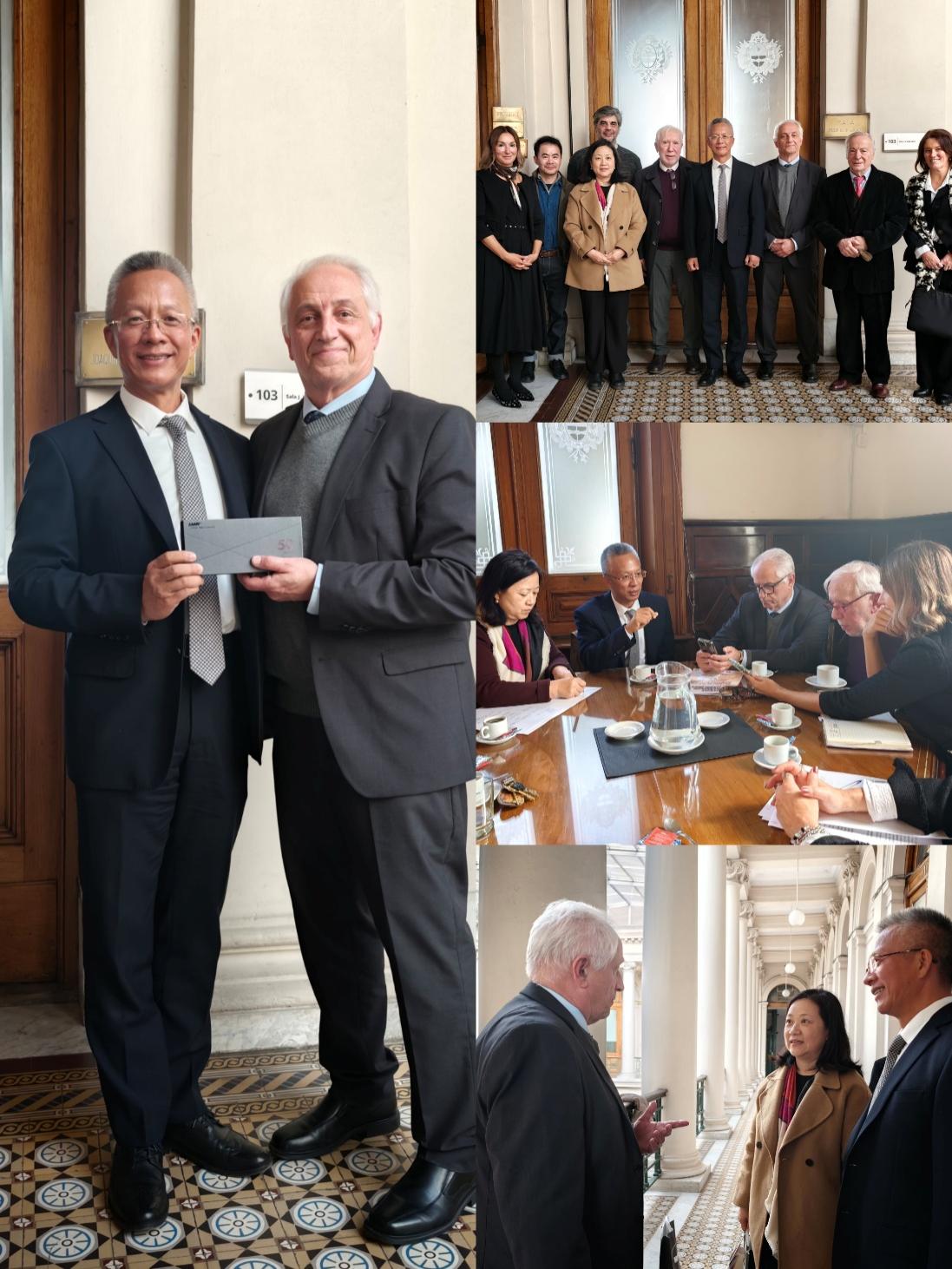
The delegation holds talks with the National University of La Plata and uses a mobile phone real-time translation function
On August 21, the delegation traveled to Montevideo, the capital of Uruguay, for a visit. This trip was a pioneering visit by our university's delegation to universities in Uruguay. During the visit, Julio Fernández, President of the Catholic University of Uruguay, met with the delegation and extended a warm welcome. He introduced the university's teaching infrastructure and teaching arrangements and expressed the hope of carrying out multi-level exchanges and cooperation with our university. Cai Jianping and his delegation held a working meeting with Gustavo Monzón, Vice President of the Catholic University of Uruguay, and heads of multiple departments of the university.
Cai Jianping focused on introducing our university's strengths in discipline development, AI-enabled education, teaching and scientific research, and related work on precision communication research concerning Latin American countries and regions. Vice President Monzón introduced the university's development philosophy and international training program for students as the first private university in the country. The two sides held working discussions on cooperation and joint scientific research in such areas as media education and intelligent communication, research on Latin American countries and regions, and exchanges of teachers and students, and reached preliminary intentions for cooperation. After the meeting, the delegation also visited the university's visual arts laboratory and radio and television studio.
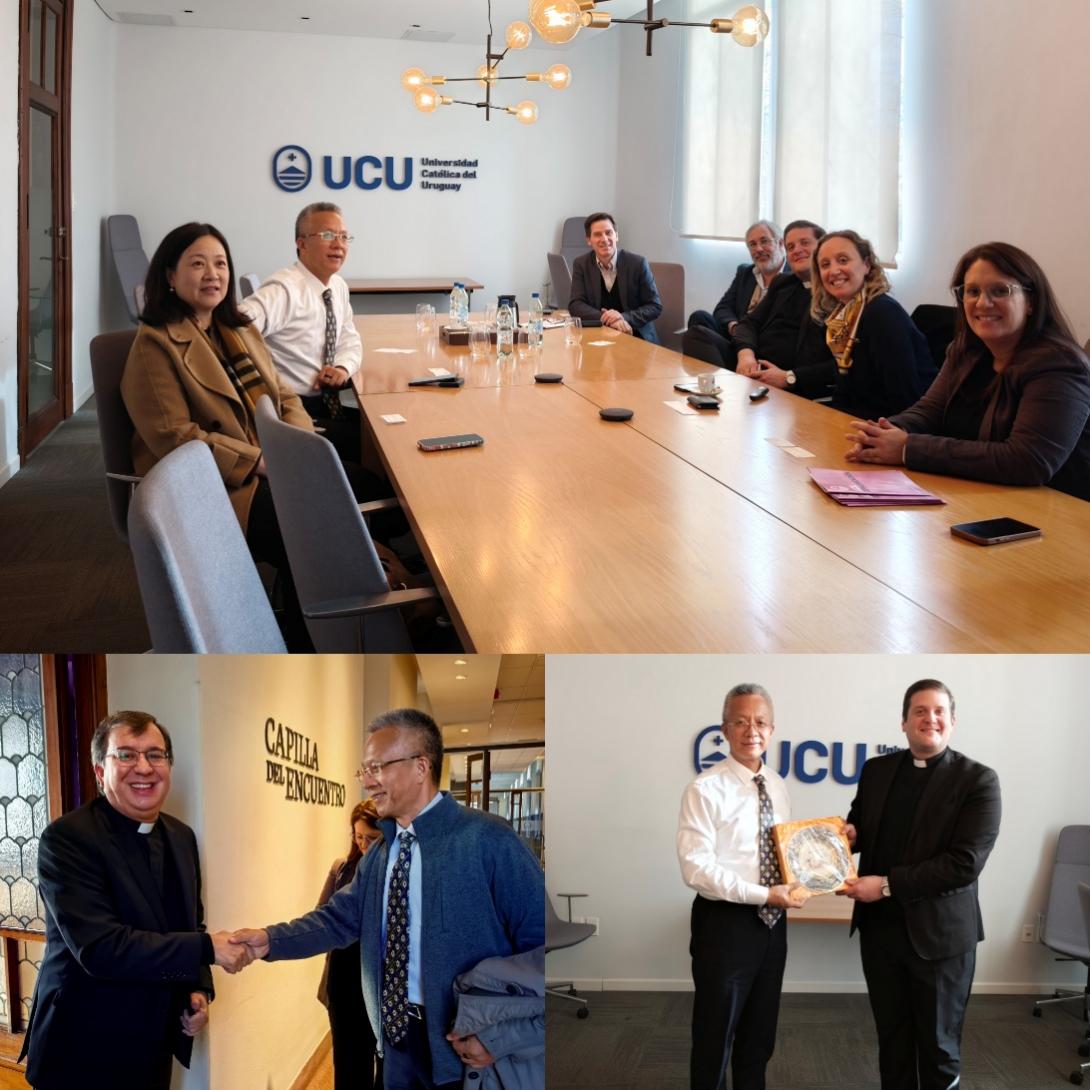
Vice President Cai Jianping meets and exchanges with President Fernández (bottom left) and Vice President Monzón (bottom right)
During the visit to Uruguay, the delegation also visited the University of the Republic of Uruguay, the country's only public comprehensive university. The delegation held a working meeting with Federico Beltramelli, Dean of the Faculty of Information and Communication of the university, Gabriel Kaplún, a senior professor of the faculty and President of the Latin American Association of Communication Researchers (ALAIC), and heads of multiple departments and institutes. Cai Jianping exchanged views with the counterparts on deepening cooperation between the two universities in China-Latin America information and communication education and scientific research, artificial intelligence applications and governance, and comparative research on journalism and communication. Dean Beltramelli introduced the faculty's disciplinary structure and research characteristics and expressed the hope that the two sides would sign a memorandum of cooperation as soon as possible and, on this basis, carry out multi-level exchanges and cooperation. Professor Kaplún, President of the Latin American Association of Communication Researchers, also expressed the association's intention to conduct joint scientific research and publication cooperation with our university. The two sides exchanged views on specific areas of cooperation and the relevant process.
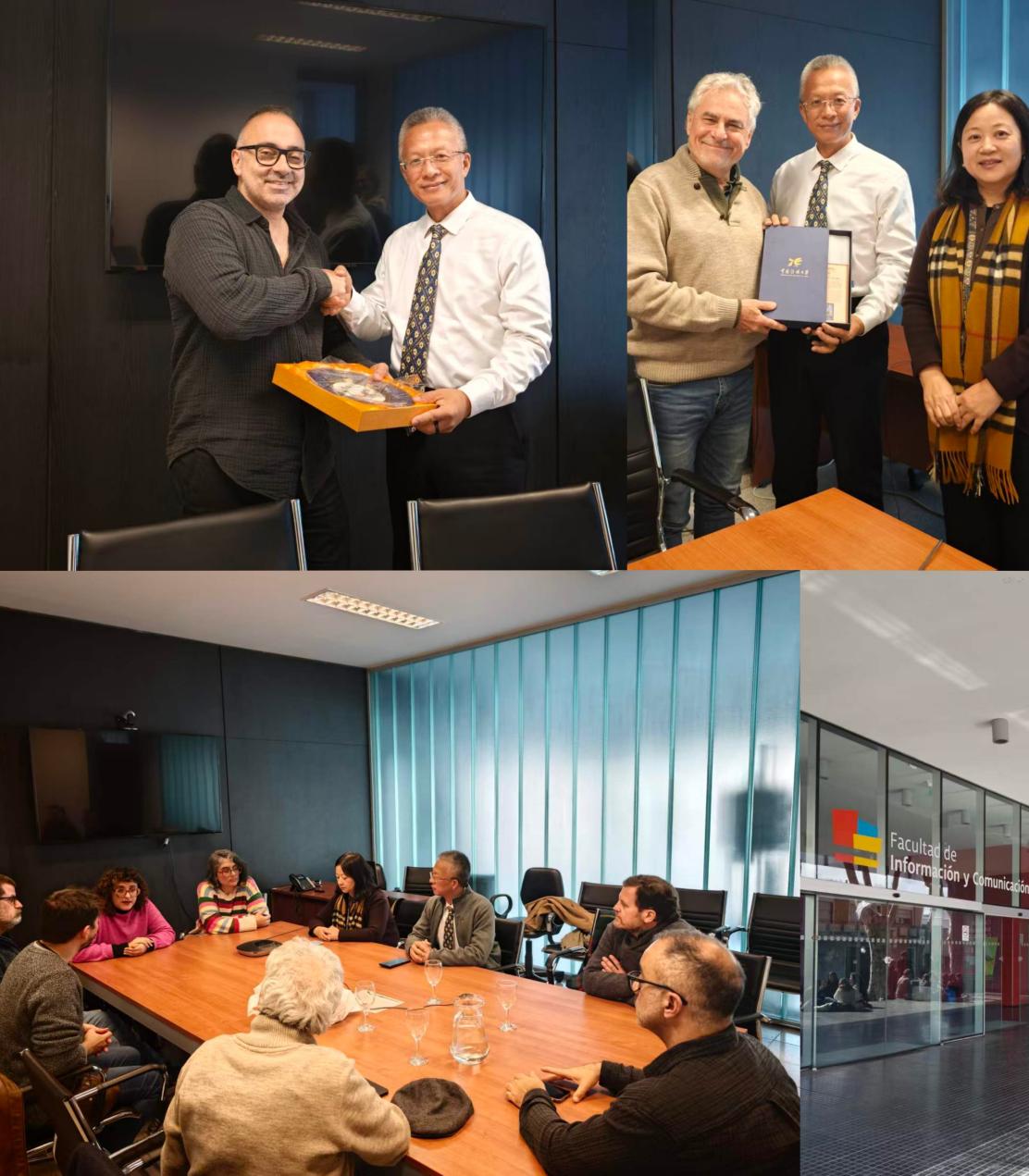
The delegation holds talks at the Faculty of Information and Communication of the University of the Republic of Uruguay
Conducting Field Research at Confucius Institutes and Media Institutions in Latin America and Building Bridges for Mutual Learning Between Chinese and Latin American Civilizations
During this visit, the delegation also conducted field research at local Confucius Institutes and Chinese-language media. On August 18, the delegation visited the Confucius Institute at the National University of La Plata, where it held in-depth exchanges with Long Minli, the Chinese Director, and others on topics including Chinese-language teaching and cultural exchanges between China and Argentina. During the Latin American China Studies Conference, the delegation also held in-depth exchanges with heads of Confucius Institutes from countries including Colombia and Ecuador, as well as scholars from Chile, Mexico, and several other countries. On August 20, the delegation visited Buenos Aires Chinese Radio Station, where it exchanged views with the team led by its head, Carlos Lin, on topics including China-Latin America media cooperation, Chinese-language media in Latin America, and the promotion of China-Latin America economic and trade exchanges through China-Latin America media.
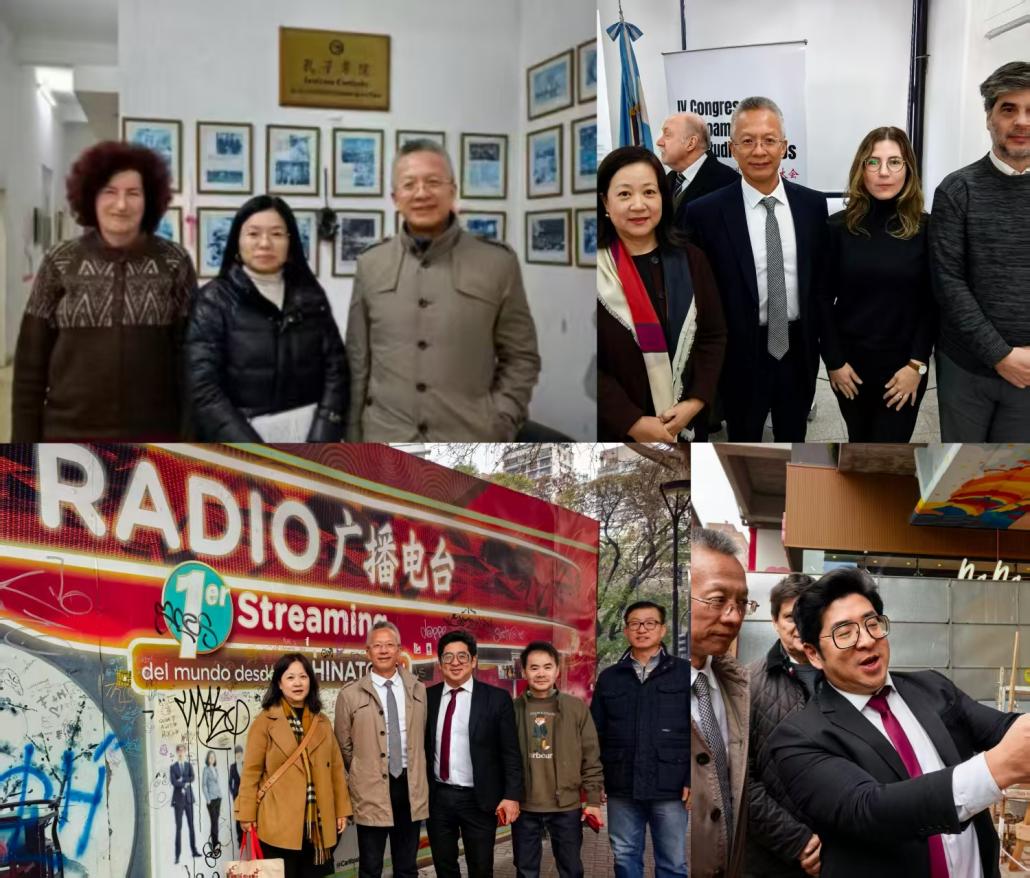
The delegation conducts research at the Confucius Institute at the National University of La Plata and Buenos Aires Chinese Radio Station
At the university development level, the visit closely followed the overall goal of building our university into a world-renowned, high-level university of communication, further expanding our cooperation and exchange framework and partnership network in Latin America, promoting the achievements of our university's practice in AI-enabled education and teaching reform, and continuously enhancing the university's visibility and reputation in Latin America.
At the level of practical cooperation, the delegation deepened cooperation between our university and key universities and institutions in Latin America in such fields as AI governance, international communication, and people-to-people and cultural exchanges. It established a new platform and expanded the cooperation resource network for our university's subsequent work in research on Latin American countries and regions, as well as education, teaching, and comparative research in information and communication. It also took a solid step forward in promoting international exchanges and joint scientific research cooperation between our university and Latin American universities.
This article was translated with AI assistance.
Editor: Fang Yiran